
2025 KIC Review: Innovation in Clinical Trials Driven by Technological Advancement
페이지 정보


본문
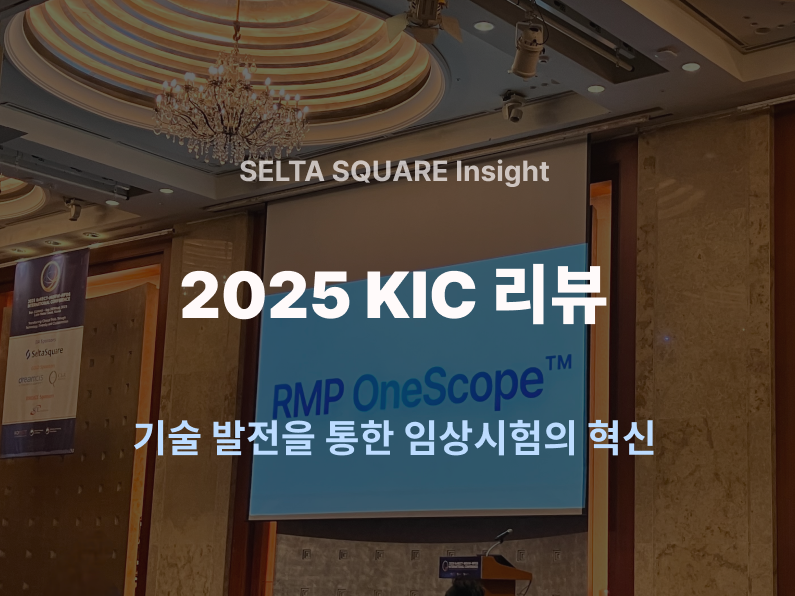
The 2025 Korea International Conference (KIC), co-hosted by the Ministry of Health and Welfare (MOHW) and the Ministry of Food and Drug Safety (MFDS), brought together global and domestic experts in clinical trials, drug development, and regulatory science over three days under the theme of “Innovation in Clinical Trials through Technology, Diversity, and Collaboration.” Through this event, SELTA SQUARE’s Clinical Strategy team reviewed global clinical trial trends and the domestic landscape, and summarized the key takeaways into four major themes.
1) The Global Shift Toward Real-World Evidence (RWE)
The use of Real-World Evidence (RWE), once primarily limited to post-marketing safety and effectiveness evaluation, is now emerging as a core driver across the entire drug development lifecycle. Internationally, improvements in data accessibility and analytical methodologies are expanding the role of RWE in both clinical development and regulatory decision-making.
In particular, the FDA and EMA are increasingly leveraging RWE as a key evidentiary source in areas such as rare diseases and oncology, including its use to support regulatory approvals. RWE is also being applied earlier in development for: Indication exploration for mechanism-based therapies, Clinical trial protocol design, Innovative trial formats such as basket trials and platform trials, Optimization of patient recruitment strategies. This shift highlights the growing importance of integrated evidence generation strategies from the earliest stages of drug development in close collaboration with regulatory authorities.
In Korea, efforts are also underway to strengthen structured data ecosystems, which is expected to improve global competitiveness by addressing key challenges in drug development.
2) Risk-Based Quality Management (RBQM)
As clinical trials become increasingly complex and costly, Risk-Based Quality Management (RBQM) is gaining importance as a proactive approach to identifying and managing risks from the earliest stages of development. Regulatory authorities such as the FDA and EMA continue to support more efficient and risk-based monitoring approaches, and investment in systems aligned with ICH guidelines has become a global trend.
Key principles emphasized include: Integrating benefit–risk assessment early in clinical development, Embedding risk considerations directly into protocol design, Focusing monitoring efforts on critical data points impacting trial quality, Enhancing efficiency through targeted, data-driven monitoring strategies. In addition, there is increasing emphasis on early implementation of signal detection and risk escalation frameworks as part of a unified safety management plan across the clinical lifecycle.
This proactive approach not only improves trial quality and reduces operational costs but also strengthens regulatory confidence in an organization’s risk management capabilities, ultimately enhancing global competitiveness.
3) Clinical Operations Transformation through AI and Digital Technologies
Clinical trials have traditionally been burdened by high documentation load and repetitive processes, leading to inefficiencies and increased risk of human error. AI and digital technologies are now emerging as key enablers to fundamentally transform these limitations.
Key developments include: Automation of medical writing and regulatory document generation using AI, Development of customized prompt-based frameworks to ensure both regulatory compliance and quality standardization, Human-in-the-loop validation processes to maintain oversight and accuracy, Digital labeling solutions to optimize supply chain and inventory management, Integrated digital documentation systems for ISF and decentralized clinical trial (DCT) operations.
These global trends indicate that AI and digitalization will become critical enablers of productivity, transparency, and operational excellence across the full clinical trial lifecycle, ultimately supporting global-level execution capabilities.
4) The Rise of Patient-Centric Clinical Trials
Clinical trials are increasingly being recognized not only as research activities but also as important therapeutic opportunities for patients.
Key patient-centric strategies discussed include: Use of biomarker-driven and diagnostic-based patient stratification to improve treatment success rates, Design of patient-friendly clinical protocols to enhance participation, Expansion of decentralized clinical trial (DCT) models to improve accessibility, Development of hospital-based research support programs to accelerate patient identification and enrollment.
In parallel, domestic policy efforts are also underway to expand clinical trial participation beyond major metropolitan areas, promoting broader regional access and reducing structural concentration in urban hospitals.
5) SELTA SQUARE’s Strategic Response
The changes observed at the KIC 2025 site are closely aligned with the direction already pursued by SELTA SQUARE’s Clinical Strategy Division and have further clarified the strategic execution areas we need to focus on going forward.
- SELTA SQUARE is proactively building an application foundation to conduct RMP-based RWD/RWE research. Through industry–academia collaboration, we have established a research environment leveraging RWD/RWE and are advancing evidence generation aligned with global standards. In particular, we are leading RWD research for active pharmacovigilance.
- SELTA SQUARE has internalized Risk-Based Quality Management (RBQM) as a core pillar for enhancing the reliability and efficiency of clinical trials. We have established SOPs for RBQM execution and strengthened our internal systems to ensure robust implementation.
- Based on its AI and digital technologies, SELTA SQUARE is delivering a balanced approach that enhances efficiency while ensuring regulatory compliance and quality through a human-in-the-loop process.
6) Closing Remarks
Clinical trials are entering an era where technology, quality, and patient-centricity must advance simultaneously.
SELTA SQUARE’s Clinical Strategy Division continues to interpret these changes from a field-oriented, data-driven perspective, striving to deliver practical and actionable solutions for researchers, operational teams, and the broader pharmaceutical industry.
- PrevGlobal Standard-Based PV AI Practical Roadmap: CIOMS 7 Principles (Part 1) 2026.05.08
- Next2025 KIC Safety Management Session Review 2026.05.08
